

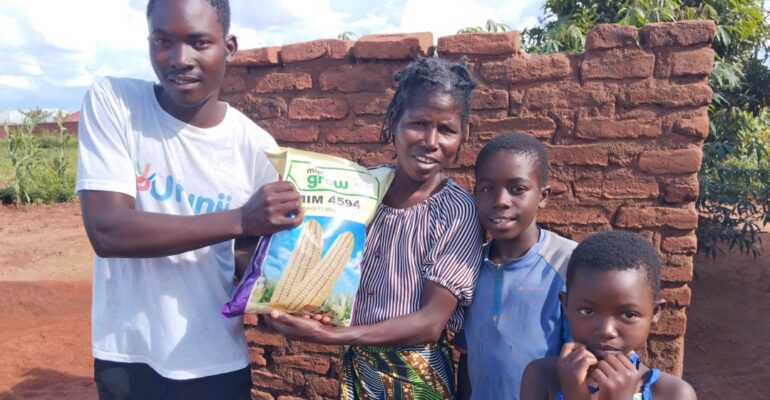
Dueck Family Challenge: Planting Seeds of Hope in Malawi
In a world where charity often comes in the form of short-term relief, one family has chosen a different path—one that plants hope not just for today, but for generations to come.
Why seeds instead of food aid?
Malawi is a beautiful country known as the Warm Heart of Africa, but it is also one of the poorest nations on earth. Many families depend on small-scale farming for survival, yet they often lack access to quality seed and basic farming tools. Agriculture is the backbone of Malawi’s economy and employs the majority of the population, yet poverty and food insecurity remain widespread.
Maize is the country’s staple food, and for many families, a good maize harvest determines whether they will eat well or struggle through the year.
However, challenges such as drought, rising input costs, and lack of farming inputs mean that many households run out of food months before the next harvest.
This is where the Dueck Family Challenge makes a difference.
Instead of providing food that is quickly consumed, the Dueck family is investing in something far more sustainable: the ability for families to feed themselves.
A simple gift that changes everything
For just $50, a struggling family receives maize seed and a hoe—the basic tools needed to cultivate their own field. This simple intervention can help feed an average family of six people. But the impact goes beyond food on the table.
This story is happening right now…
Takondwa’s family is still waiting. For $50, you can give them seeds, a hoe, and a harvest.
Give $50 — feed a family nowTax-deductible in the USA · Urunji covers admin costs
When a family has enough to eat, children are more likely to stay in school. Parents can focus on building their livelihoods instead of worrying about their next meal. And when harvests are good, families can even sell surplus maize to meet other needs such as school supplies, clothing, or medical care.
In other words, a small investment in seed becomes an investment in dignity, resilience, and opportunity.
From dependency to dignity
Food aid certainly has its place in emergencies. But long-term transformation often comes when people are given the opportunity to work their own land and provide for their own families.
This is what makes the Dueck Family Challenge so compelling. It shifts the story from dependency to empowerment.
It says to vulnerable families: You are not forgotten. You are capable. Here are the tools—now you can grow.
And the results are tangible. A field that might have remained empty begins to show green shoots. A family that once worried about hunger begins to plan for the future. A simple hoe and a bag of seed become symbols of hope.
One family at a time
What makes this story especially inspiring is its simplicity. The Dueck family is not trying to solve everything at once. They are simply helping one family at a time, one month at a time.
That is how real change often happens—not always through large programs, but through consistent, faithful acts of generosity.
And what if others joined this challenge?
What if more families, churches, or individuals decided to sponsor just one farming family? The ripple effects could reach hundreds of lives, strengthening communities and building food security from the ground up.
You can plant a seed too
The beauty of this initiative is that anyone can participate. You do not need to give thousands of dollars to make a difference.
Just $50 provides maize seed and a hoe for one family.
That is the power of a seed. It may look small, but when planted in good soil, it multiplies. The Dueck family has started the challenge. Now the invitation is open.
Will you plant the next seed of hope?
The Dueck family has committed to one family every month. Your $50 becomes $100 — enough to plant a field, feed six people, and keep a child in school.
Join the challenge — give $50 todayTakes 2 minutes · Secure · Tax-deductible in the USA
| Your gift | What it does |
|---|---|
| $25 | Seeds for half an acre |
| $50 | Seeds + hoe — full family package |
| $100 | Two families, fully equipped |
