

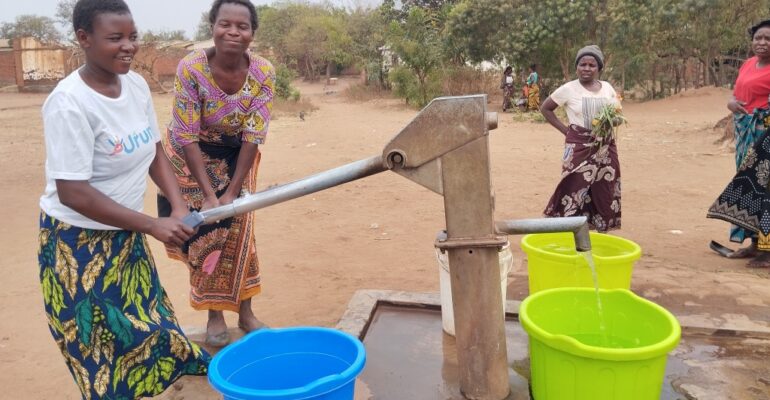
13 Years Later, the Water Is Still Flowing: What One Borehole Tells Us About Lasting Impact
Thirteen years ago, Urunji Child-Care Trust drilled a borehole at Mwatibu School in rural Malawi.
At the time, it was simply a water project. Children needed reliable access to water at school, and the surrounding community needed a dependable source of this essential resource.
But today, that borehole tells a much bigger story. Thirteen years later, the borehole is still operational. The water is still flowing.
For Urunji, this is more than an encouraging project outcome. It is evidence of an important principle that has guided our work for many years: development should not only address today’s needs. Whenever possible, it should create solutions that continue serving people long into the future.
Choosing quality over the cheapest option
When Urunji undertook the Mwatibu School borehole project in 2013, we had a choice.
We could look for the least expensive way to complete the project, or we could invest in a higher-quality installation designed to last.
The second option was more expensive. We chose it anyway.
That decision required looking beyond the immediate project budget and asking a different question: What will provide the greatest value to this community over the lifetime of the investment?
A cheaper borehole might have reduced the initial cost, but if it failed after only a few years, the community would once again face the same problem. Repairs would require additional resources, and children would once again have to cope with unreliable access to water.
Instead, Urunji invested in a borehole built to high specifications.
Thirteen years later, that investment continues to serve.
You too can provide water that will last for years to come. Partner with us now…
The real value of an investment is sometimes measured in years
Development work is often measured by what happens during the period of a grant.
A project receives funding. Activities are implemented. Outputs are recorded. A report is submitted.
But some of the most meaningful results happen after the project officially ends.
The Mwatibu borehole is a good example…
The original project may have been completed more than a decade ago, but its usefulness did not end when the project report was written. The infrastructure continued serving children and the wider school community year after year.
This is why we believe that the true value of development investment should sometimes be measured not only in what was achieved when the funding was available, but also in what continues to work after the funding has ended.
That is the kind of impact we want to create at Urunji.
Water is about much more than water
For a child attending school, access to water can affect many aspects of daily life.
A reliable water source helps schools maintain a healthier environment. It supports hygiene and sanitation. It reduces the burden associated with finding water. It helps create conditions in which children can concentrate on what they came to school to do: learn.
In rural communities, reliable water infrastructure can also have benefits that extend beyond the school itself.
That is why water projects are an important part of Urunji’s broader work to help communities discover pathways out of extreme poverty.
Since our work began, Urunji has drilled or repaired 39 boreholes serving more than 26,500 people.
Every one of those numbers represents people, families, children and communities whose daily lives are affected by access to water.
And the Mwatibu borehole reminds us that when infrastructure is built well, its impact can continue for many years.
Building for the long term
At Urunji Child-Care Trust, our mission is to help communities discover pathways out of extreme poverty.
We know that poverty is complex. It cannot be solved through a single intervention.
That is why our work includes education, nutrition, early childhood development, livelihoods, women’s empowerment, regenerative agriculture, skills development and access to essential infrastructure.
Across these areas, however, there is a common philosophy: We want to create solutions that communities can continue to benefit from.
When we support a woman with skills and business capital, we want her to develop an income that can support her family beyond the period of our intervention.
When we plant trees, we want those trees to continue providing environmental benefits years into the future.
When we support a child through education, we want the benefits of that education to extend throughout that child’s life.
And when we build a borehole, we want the water to keep flowing.
The Mwatibu borehole is therefore not just a story about water. It is a story about thinking beyond the project cycle.
What does your donation make possible?
For a donor, it can sometimes be difficult to know what happens to a donation after it has been given.
Does it really make a difference?
Does the project continue after the funding ends?
Does the investment create lasting change?
We cannot promise that every project will last for 13 years. Circumstances change, infrastructure eventually requires maintenance, and communities face challenges that cannot always be anticipated.
But we can make deliberate choices about the quality and sustainability of the interventions we undertake.
The Mwatibu borehole demonstrates what can happen when we do.
A decision made in 2013 is still benefiting children in 2026.
That is the kind of long-term thinking we want to bring to our work.
Help us build what will still matter years from now...
There are many communities in Malawi that still need reliable access to water.
There are children who need better educational opportunities. There are women who need skills and opportunities to generate sustainable incomes. There are families who need pathways out of poverty rather than temporary relief from it.
Your financial support can help Urunji respond to these needs. But we want to do more than respond to today’s problems.
We want to build solutions that will still matter years from now.
Perhaps the next borehole we build will still be serving children 13 years from today.
Perhaps the girl who receives skills training today will be supporting her family years from now.
Perhaps the tree planted today will still be standing when today’s children become parents.
That is the kind of future we are working to create.
